Electronic voting at universities: UdeC and USACH elected their rectors with EVoting
Written by Joaquín Aaron González / May 05, 2026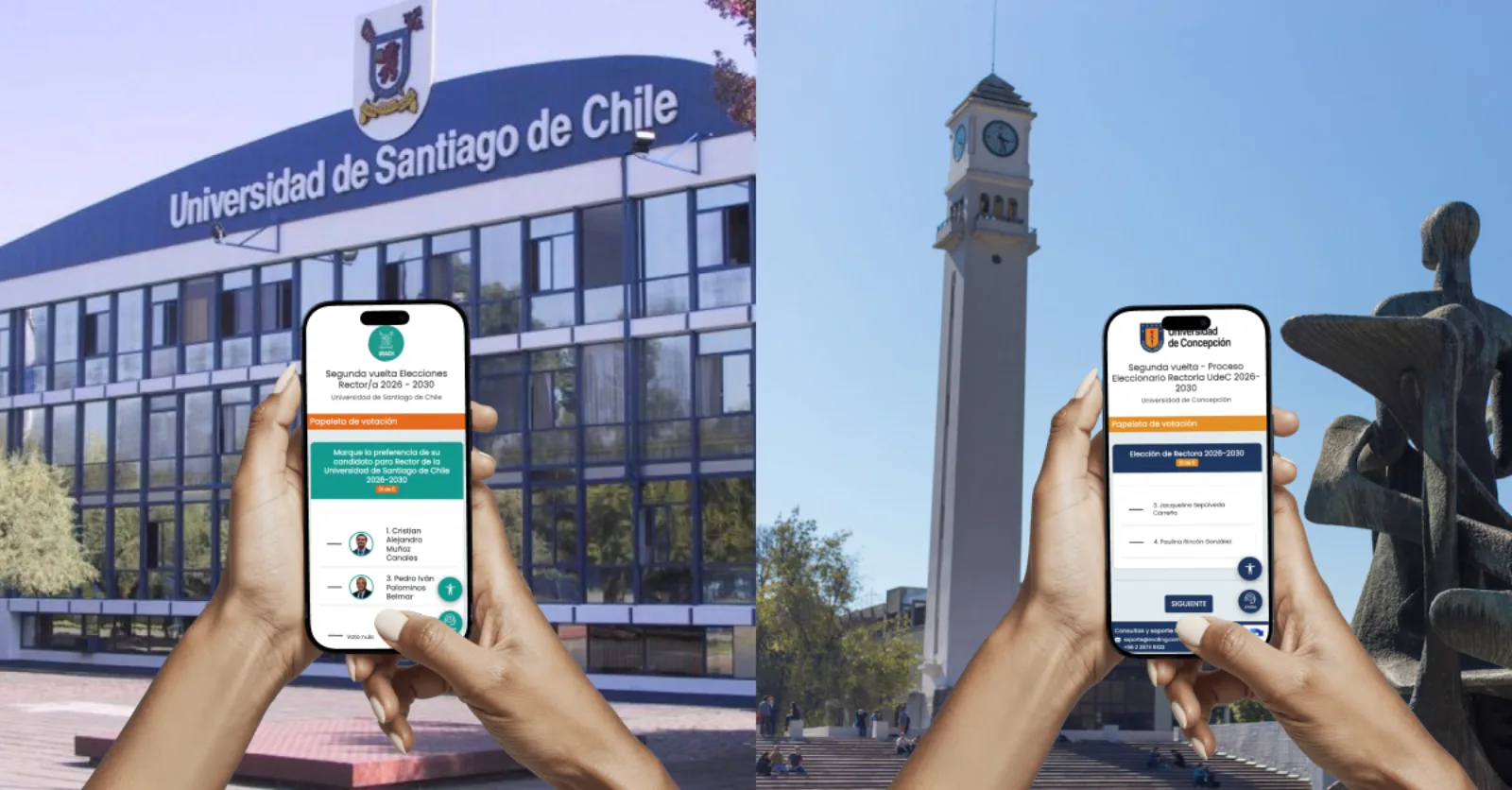
Universities across the continent are transforming how they elect their authorities. The University of Concepción and the University of Santiago de Chile are two of the most emblematic recent cases in Chile.
More and more universities are choosing to digitise their electoral processes, and April offered a clear example of how technology can support academic participation in different settings.
The University of Santiago de Chile once again elects its rector with EVoting technology
In 2022, during the pandemic, USACH elected its rector using technological means for the first time. At the time, the rector-elect said: “It has been an impeccable process; we have had great confidence in the work carried out by EVoting.”
Four years later, the institution once again held its rector election electronically, now with greater experience after digitising more than 50 votes, including student and dean elections.
As in the university's most recent electoral processes, an in-person voting point with EVoting support was made available so that voters could receive assistance and cast their ballots correctly.
One relevant development was the inclusion of hourly-paid lecturers on the electoral roll, with each lecturer receiving a weighted vote according to the percentage of time they teach. The voting system was adapted to the university's requirements for this purpose.
The election ended with a historic turnout of 2,130 voters in the second round. Dr Pedro Palominos won with 52.58% of the valid votes cast.
The University of Concepción elects its first female rector
On 8 April, the University of Concepción elected the first female rector in its history, using digital tools alongside the traditional paper ballot.
This coexistence of voting methods had already been used in the 2022 rector election. Before the election, voters could voluntarily switch from the traditional method to digital voting. Those who retained paper voting could cast their ballot at Casa del Deporte, while those who preferred the remote option could vote through the website provided by EVoting.
Voters registered on the digital roll could also go to Casa del Deporte and vote electronically in person, as the university provided a dedicated polling station for these cases.
This innovation enabled votes to be received from 12 countries, including the United States, Japan, France and Belgium. Electronic voting accounted for 99.16% of ballots in the first round and 98.31% in the second, exceeding the figures from the 2022 election. Dr Paulina Rincón won the election and became the first female rector in the history of the University of Concepción.
Other electronic voting experiences at universities
These institutions join a long list of universities that have chosen to digitise elections across their different constituencies.
Recently, the National Autonomous University of Honduras, the country's leading academic institution, incorporated digital voting into its 2026 student elections to make the process more efficient and secure. Turnout reached 40%, with more than 31,000 votes cast across 136 electoral processes and 186 candidates.
During election day, the platform achieved 100% availability and made it possible to monitor voting progress in real time. The system also included candidate logos and photographs to facilitate identification, together with active technical support throughout the process.
Other institutions with digital voting experience include the University of Costa Rica, the Costa Rica Institute of Technology, the University of Cuenca in Ecuador and Universidad del Desarrollo, among others that have adopted digital tools to strengthen their electoral processes.